
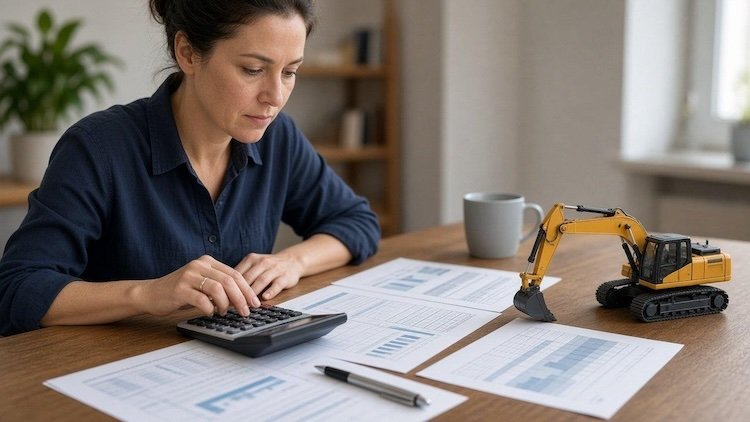
Few financial decisions feel as permanent for a small business as buying equipment. Whether it is a delivery van, a commercial oven, a 3D printer, a set of power tools or a construction machine, the purchase price is visible and painful. Renting or leasing often looks like an easy way to avoid that pain, but monthly payments add up too.
The right answer depends on numbers, not instinct. This guide walks through the cost math behind renting, leasing and buying so that small business owners can compare options on a fair basis.
Step 1: Estimate Real Utilisation
Everything starts with one question: how often will you actually use the equipment? Not how often you hope to use it, but how often you realistically will.
Look at past jobs, bookings or production records. If you have been renting the item already, count the rental days over the last year. If it is new to your business, estimate conservatively.
Utilisation drives everything else. Equipment used most working days behaves very differently financially from equipment used a few weeks per year.
Step 2: Calculate the Total Cost of Ownership
The purchase price is only the beginning. To compare fairly, add up the full cost of owning over the period you expect to keep the equipment:
- Purchase price (or down payment plus loan repayments)
- Interest on any financing
- Insurance
- Maintenance and repairs
- Storage and security
- Transport to and from jobs
- Downtime costs when the equipment breaks and you have to rent a replacement anyway
Then subtract the expected resale value at the end of the period. The result is your true net cost of ownership.
Tax rules can also change the numbers. Depreciation and expensing rules allow businesses to deduct some or all of the cost of equipment over time. The IRS guide to depreciating property (Publication 946) explains these rules for US businesses, and similar capital allowance systems exist in many other countries. Speak to an accountant before assuming the tax benefit.
Also Read: How to Start Small Business Tips for Beginners
Step 3: Calculate the Cost of Renting
Renting costs are simpler to calculate but easy to underestimate. Include:
- Daily, weekly or monthly rental rates
- Delivery and collection fees
- Damage waivers or insurance
- Fuel or consumables
- Late return charges if they are likely
Multiply by your expected utilisation. Remember that longer rental periods usually come with lower daily rates, so a month of rental is often much cheaper than thirty single days.
Step 4: Calculate the Cost of Leasing
Leasing sits between renting and buying. Add up:
- Monthly lease payments over the full term
- Any upfront deposit or fees
- Maintenance costs if they are not included
- End-of-term charges or purchase option price
Compare the total to ownership and rental costs at the same utilisation level.
A Worked Example
Imagine a landscaping business considering a compact excavator. These figures are illustrative, not quotes.
- Buying: purchase price of 30,000, expected resale after five years of 12,000, plus around 2,500 per year for insurance, servicing, storage and transport. Net five-year cost: 18,000 + 12,500 = 30,500, or about 6,100 per year.
- Renting: around 180 per day, or about 650 per week including delivery.
- Leasing: around 650 per month for five years, plus around 1,000 per year in maintenance. Five-year cost: 39,000 + 5,000 = 44,000, or about 8,800 per year, with no asset at the end unless you pay to buy it.
Now apply utilisation:
- At 6 weeks per year, renting costs about 3,900 per year. Renting wins clearly.
- At 12 weeks per year, renting costs about 7,800 per year. Buying is now cheaper.
- At 30 weeks per year, renting costs about 19,500 per year. Buying is far cheaper.
The break-even point in this example sits somewhere around 9 to 10 weeks of use per year. Your own numbers will differ, but the method is the same.
Also Read: 8 Great Business Ideas for Young Entrepreneurs
Step 5: Factor in Cash Flow and Risk
The cheapest option on paper is not always the best choice. Consider:
- Cash flow. Buying ties up cash or borrowing capacity. If that cash would otherwise fund marketing, hiring or stock, the opportunity cost may outweigh the savings.
- Demand uncertainty. If your workload might fall, renting avoids being stuck with payments on idle equipment.
- Technology change. Equipment that becomes outdated quickly, such as computers or specialised electronics, is often better leased or rented.
- Reliability needs. If a breakdown would stop your business, owning a well-maintained machine, or leasing with a service agreement, may be worth the cost.
Many small businesses also compare equipment financing with general borrowing. This guide on how small business loans work explains the main loan types and what lenders typically look for.
Track Utilisation Continuously
The right decision can change as your business grows. An item you rent occasionally this year may become a daily need next year. Equally, a machine you bought for a large contract may sit idle once that contract ends.
Businesses that track usage closely make better equipment decisions. Rental companies themselves use a utilisation tracking tool to see exactly how often each asset earns money, and the same thinking applies to any business with equipment. Review your figures every six to twelve months and adjust: sell idle assets, buy items you keep renting and renegotiate leases that no longer fit.
Do Not Forget the Hidden Value of Flexibility
Spreadsheets compare costs well but struggle to price flexibility. The ability to stop paying when work dries up, switch to a different model for a new type of job or scale up quickly for a large contract has real value, even if it does not appear as a line item. When two options are close on cost, flexibility is often the deciding factor.
Quick Decision Guide
- Use under about 25 percent of the year: rent.
- Use regularly but need flexibility or upgrades: lease.
- Use most working days for several years: buy.
- Unsure: rent first, track utilisation, then decide with real data.
Final Thoughts
Renting, leasing and buying each have a place in a small business. The key is to compare them on total cost at realistic utilisation, then weigh cash flow, risk and flexibility. A few hours with a spreadsheet can save thousands and ensure your equipment works for your business rather than the other way round.